






The Short Answer
Use Wix if you’re starting out, have more time than money, and want to learn how to build and manage a website with no experience. Hire CW Dynamic if you’re a local service business that needs your website to generate leads and rank in Google. Wix will get you online, but the platform’s technical ceiling and lock-in costs will likely cost you more in the long run than an agency relationship would have from the start.
Side-by-Side Comparison
| Factor | Wix | CW Dynamic |
|---|---|---|
| Monthly cost | $17–$159/month (software subscription) | $54–$60/month |
| Setup time | Hours to weeks (DIY) | 48 hours to weeks (built around your business) |
| Who has to fix it | You: every update, edit, correction, and broken thing is yours to manage | Me |
| SEO control level | Capable of 80% of what most businesses need; technical ceiling on the remaining 20% | Full control, no platform constraints |
| Lock-in / portability | You own your domain name. Your site stays on Wix. You can’t take it with you. | You own the whole site. Take it anywhere, anytime. |
| Strategic guidance | None; software product only | Included; ongoing and proactive |
| Ongoing support | 24/7 chat (quality varies by plan and issue) | Direct contact with the person who built your site |
| Best for | Testing an idea. More time than money. Desire to learn how to build Wix websites. | Local service businesses that need search visibility and a real partner |
| Not ideal for | Anyone whose business depends on capturing new leads and plans to scale | Anyone who wants to manage their own site and technical issues day to day |
You’re Either About to Start on Wix, or Already Stuck in It
Maybe you pulled up the pricing page this week. $17 a month, an AI that builds the whole thing, something live by the weekend. You’re wondering: is there actually a reason to hire somebody for this?
Or maybe you already built the site. It looks fine. But it’s not ranking, you’re the one fixing every broken thing, and somewhere in the back of your mind you know this isn’t what you pictured when you started the business.
Either way, this page is for you. If you’re a contractor, an HVAC company, a local retailer, or any service business that depends on people finding you, the question isn’t really about Wix. It’s about what you need your website to actually do. There’s a version of this decision that works out fine. There’s another version that quietly becomes the expensive one. Worth knowing which you’re in before you commit.
What Wix Actually Is
Wix is a subscription-based website builder. You pay monthly or annually, you get hosting, SSL, a domain, templates, and a drag-and-drop editor. No coding required. One dashboard for most of what you need.
Pricing as of 2026: the Light plan is $17/month and gets you a custom domain with no Wix branding. The Core plan is $29/month and adds ecommerce and booking features. Business is $39/month for more advanced commerce tools.
The free plan exists, but it puts “mysite.wixsite.com” in your URL and Wix ads on every page. For any real business purpose, you’re looking at at least $17/month.
In January 2026, Wix launched Wix Harmony, their AI website builder. The AI agent, Aria, can generate pages, redesign sections, and set up commerce features from plain-language prompts. It’s available on all plans including the free tier. This is a genuinely impressive product. Anyone who tells you Wix’s AI is a gimmick hasn’t tried it lately.
Wix also ranks second among major CMS platforms for Core Web Vitals performance as of late 2025, meaning most Wix sites load fast and perform well on technical measures. The old knock on Wix for slow load times is not the argument it used to be. It’s a well-built product.
Who Should Actually Use Wix
Some of the people reading this page should close it and go sign up for Wix. Here’s who that is:
You’re starting out, have more time than money, and want to learn the platform yourself. You’re testing a business idea that isn’t proven yet and need something online to see if it gets traction. You’re a freelance photographer, illustrator, or creative who needs a portfolio and doesn’t care about local search rankings. You’re a non-profit with essentially no budget. You’re running a side project that might become a real business someday but isn’t one yet.
For those situations, Wix is the right call. It gets you online fast, at a price that’s hard to argue with, and it’ll handle the basics fine. No shame in it.
The rest of this page is for people who are past that stage, or who know from the start that they need their website to do real business work.
Where Wix Falls Short (For a Specific Type of Client)
If you’re a local service business, the kind that depends on people in your area finding you on Google when they need what you do, here’s what typically happens.
The lock-in is structural, and it’s severe.
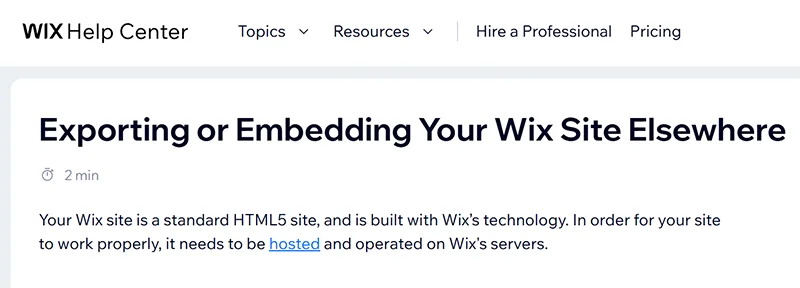
When you build a site on Wix, you’re not building an asset you own. Wix’s own help documentation confirms: there is no way to export your site. Not the design, not the page layouts, not the forms. Blog content can be exported via RSS, but without images, metadata, or formatting. Your domain name is portable. Your site is not.
What You Own
- Your domain name
That’s it.
What Stays on Wix
- Your design
- Your page layouts
- Your forms
- Your blog posts
- Your images
Leave Wix and start over.
Confirmed in Wix’s own help documentation.
This matters because businesses change. What you need from a website at year one is not what you need at year three. If you outgrow Wix, you’re not migrating a site: you’re starting over. Professional migrations from Wix to WordPress run the cost of a new site, typically between $1500 and $8000 and take significantly longer than migrations from other platforms, because Wix’s architecture isn’t designed to let you leave. HeadNorth Agency put it plainly: “Successful users of Wix will sooner or later hit a ceiling and need to rebuild elsewhere for the original investment they could have made at the start.” The $17/month option has a hidden back end.
The SEO ceiling is real, even if the floor has improved.
This one is more nuanced than it used to be. Wix has done real work on technical performance, and the old “Wix is bad for SEO” line doesn’t hold up anymore as a blanket statement. For a small business that needs basic on-page optimization and fast page loads, Wix is capable of handling about 80% of what you need.
The problem is the other 20%. URL structure has real constraints. Sitemaps are auto-generated and can’t be filtered or customized, which creates crawl inefficiency on larger sites. Schema markup for complex structured data isn’t achievable. There’s no server-level access, so custom redirects, advanced canonical tag control, and certain technical fixes are off the table. Local SEO, the specific kind of optimization that determines whether you show up when someone in your city searches for what you do, runs into real limits on the platform.
In a market where your competition is also using Wix, this might not matter. In a market where you’re up against businesses that have invested in their web presence, the gap between “ranks” and “exists but doesn’t rank” is often in that 20%.
The billing complaints are documented and consistent.
This one isn’t anecdote. Across multiple complaint platforms: auto-renewal turned back on after explicit cancellation, charges made to cards after users thought they’d cancelled, difficulty getting refunds, account suspensions when users dispute charges. ComplaintsBoard shows a 1-star average from 151 reviews. PissedConsumer has 375 reviews averaging 1.5 stars, with roughly 10% of reviewers willing to recommend the service.
A software company’s incentive is to keep you subscribed. That’s not a character attack on Wix; it’s just how the business model works. When a renewal dispute happens, the incentives don’t favor you.
Template changes mean starting over.
If you build a site on one Wix template and later want a different design, your content doesn’t transfer. You rebuild. For a business that’s changing how it presents itself, which happens regularly over a few years, this is a significant hidden cost.
What CW Dynamic Does Differently

For local service businesses looking for a real Wix alternative, the short version is this: Wix’s job is to keep you subscribed. My job is to get you results.
That’s not a knock on Wix. It’s just a description of two different business models. Wix is software. I’m a service.
In practice, here’s what that looks like.
When I build a site for a client, they own it. If they ever decide to go a different direction, different platform, different agency, handle it themselves, they walk away with the site. There’s no hostage situation.
On SEO: I’m not running a tool that auto-generates recommendations. I’m looking at what your actual competitors are ranking for, where the gaps are, and what’s technically holding your site back. For a contractor in a market with real competition, that specificity matters. That specificity is what produces results in a competitive local market.
At six months in, I know your business. I know which services are your highest margin, which neighborhoods you want more work in, what’s coming up seasonally. When something changes, a Google algorithm update, a competitor running an aggressive campaign, you wanting to add a new service, you don’t have to catch me up from scratch. I already know the context.
At two years in, that compound knowledge is hard to replicate. Not because I’m irreplaceable, but because the relationship means we’re working toward your specific goals, not managing a software account.
The people I’m not a fit for: someone who wants to manage their own site and technical issues day to day, someone who’s just testing an idea, someone who doesn’t need their website to generate leads. For those people, Wix is genuinely the better answer, and I’ll say so in a conversation.
The people I work with are typically past that point. They need someone who picks up the phone, knows their business, and is accountable for results, not a support queue.
The Bottom Line
If you’re just getting started and not sure your business idea is going to take off, use Wix. Seriously. The $17/month plan will get you online, the AI builder is legitimately good, and you can always revisit this decision when you’re ready to invest in growth.
If you’re a local service business that depends on Google to bring in customers, and you’ve been in business long enough to know this is real, Wix will get you online but probably won’t get you ranking. And the exit cost when you outgrow it is a lot higher than the monthly subscription suggests.
The question isn’t really Wix vs. an agency. It’s what you need your website to do. If it’s “exist,” Wix works. If it’s “generate leads,” that’s a different conversation.
Frequently Asked Questions
Is Wix cheaper than hiring a marketing agency?
In the short term, yes. Wix starts at $17/month. CW Dynamic’s monthly rate runs $54–$60. The math changes when you factor in what you’re actually buying: Wix is software that gets you online. An agency is a service that gets you results. If your website needs to generate leads and rank on Google, the cheaper option up front is often the more expensive one by year two, especially once you add the $1,000–$5,000 cost of migrating off Wix when you’ve outgrown it.
Does Wix work for local SEO?
Wix covers the basics: page titles, meta descriptions, fast load times. It ranks second among major CMS platforms for Core Web Vitals performance, so slow page loads are less of a concern than they used to be. The ceiling is in the technical details: URL structure constraints, auto-generated sitemaps you can’t customize, and limited schema markup. In a low-competition market that ceiling might not matter. In a market where you’re competing against businesses that have invested in their web presence, the gap between “ranks” and “doesn’t rank” is often in that 20% Wix can’t reach.
Can I switch from Wix to a professional agency later?
Yes, but it costs more than starting with an agency from the beginning. Wix does not allow you to export your site: not the design, not the page layouts, not the forms. What that means in practice is that a move away from Wix is a rebuild, not a migration. Professional rebuilds typically run $1,500 to $8,000 and take significantly longer than moving from other platforms, because Wix’s architecture isn’t built to let you leave. The monthly subscription is inexpensive. The exit is not.
Ready to Talk?
If this sounds like the kind of relationship you’ve been looking for, the first step is a free 30-minute discovery call. No pitch, no pressure, just a conversation about where you want to go and whether we’re a fit.